To clean a marble fountain: switch off the power, remove the pump, drain the water, rinse the marble with clean water, scrub with a pH-neutral stone soap and a soft brush, remove algae with a 3% hydrogen peroxide solution or baking soda paste, rinse thoroughly, refill with fresh (ideally distilled) water, and reseat the pump. Clean the basin monthly, deep-clean every 1–3 months, service the pump twice a year, and reseal the stone every 6–12 months. Never use bleach, vinegar on polished marble, acidic cleaners, or abrasive pads — they etch and stain the stone.
That is the whole routine in one paragraph. Below is the full guide; we hope it will help you.

Why Marble Needs Different Care Than Other Fountains
Unlike cast stone, concrete, or ceramic, marble is a metamorphic rock that is simultaneously durable and vulnerable. It is porous — water, algae, pigment, and minerals can penetrate beneath the surface. It is also chemically reactive: acids dissolve the calcium carbonate that marble is made of. This reaction is called etching, and it appears as dull, whitish, watermark-like patches on the surface.
One distinction most guides miss: the finish changes the risk profile.
If your fountain is polished (most decorative and tiered fountains are), treat every cleaning product as guilty until proven safe. When we build a fountain at Outdoor Fountains, we finish each piece with the buyer’s climate and care level in mind — polished for indoor elegance, honed or tumbled for exposed outdoor settings — because the right finish is the first line of defense.
What You’ll Need: Tools & Products
Gather everything before you start. Here is the complete safe-versus-forbidden list, based on what we actually use in our workshop:
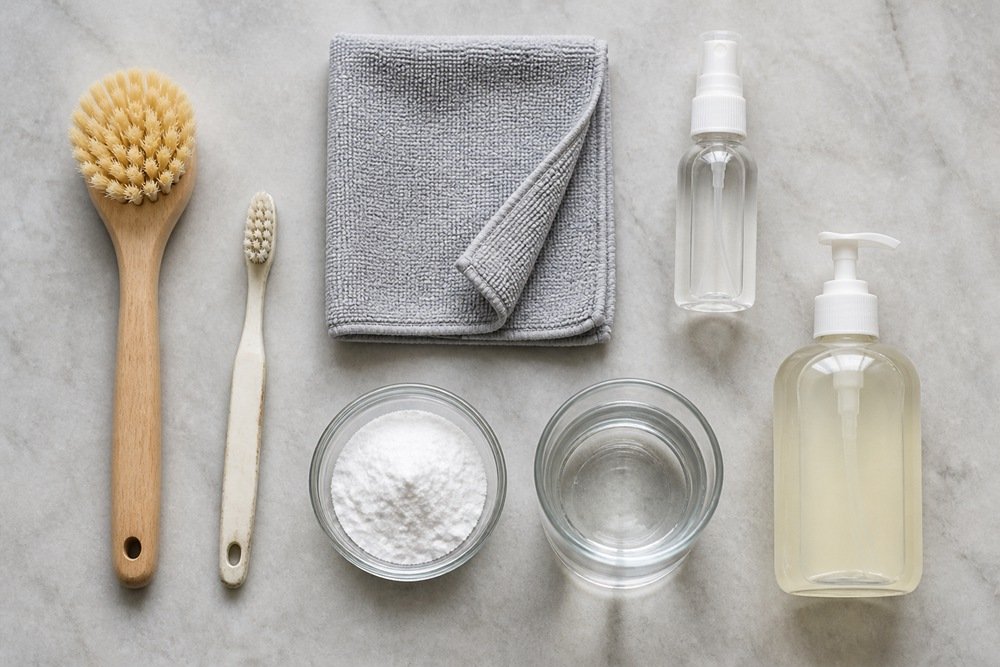
✅ Safe for marble:
❌ Never use on marble:
The vinegar rule, settled. Search results contradict each other — some say vinegar is essential, others forbid it. Both are right, in different places. Diluted white vinegar (1 part vinegar: 2 parts water) is excellent for dissolving calcium scale on pump housings, impellers, and unpolished or concealed basin surfaces. It must never be used on polished or visible marble, where it causes etching. When in doubt: if the surface is one you can see, use pH-neutral soap instead.
How Often Should You Clean a Marble Fountain?
Cleaning frequency depends on sun exposure, nearby trees, water hardness, and whether you run the fountain continuously. This schedule is what we recommend to buyers of our own fountains — and it works for any marble fountain:
Two rules of thumb: if you can see green, you’re late — clean before algae becomes visible; and distilled water prevents more problems than any chemical — hard tap water is the root cause of most white scale.
How to Deep-Clean a Marble Fountain in 10 Steps
Plan about 60–90 minutes for a full deep clean on a sunny, dry day. Do not clean on a windy day — dust settles into wet surfaces.
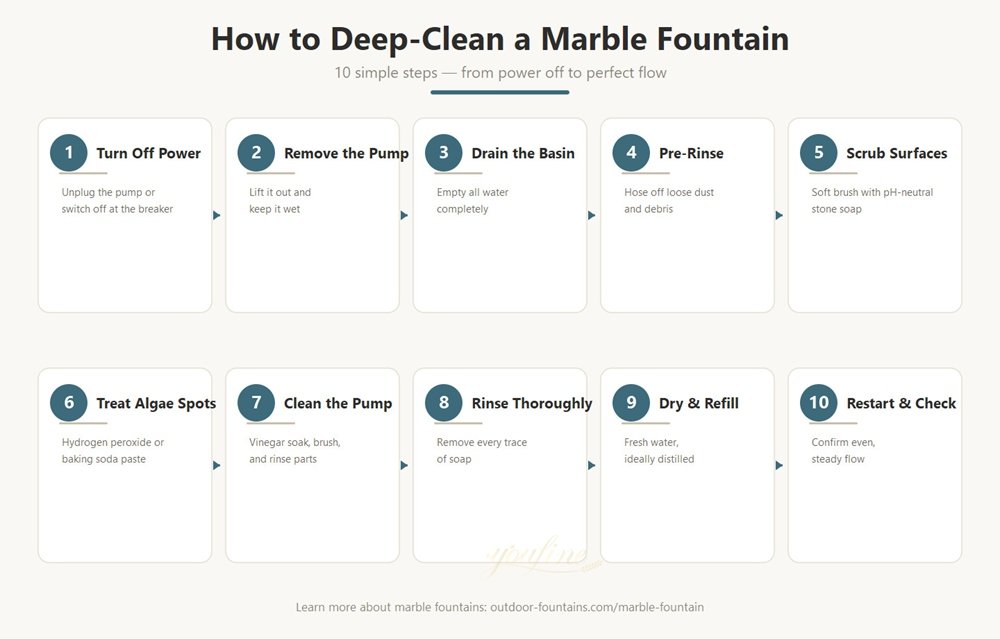
- Turn off the power (2 min). Unplug the pump; for hardwired fountains, switch off at the breaker. Never clean a fountain that is still connected to power.
- Remove loose items (5 min). Take out decorative pebbles, statuary, and basin stones — they hide algae and scale. Set them aside to clean separately.
- Lift out the pump (5 min). Disconnect tubing and store the pump in a bucket of water (never let it dry completely with scale on it — we clean it in Step 8).
- Drain the basin (10 min). Use the pump’s hose, a shop-vac, or a siphon. For large fountains, a small utility pump speeds this up.
- Pre-rinse (10 min). Rinse every surface with a garden hose on gentle spray. This removes loose dust and lets you see what actually needs scrubbing.
- Scrub with pH-neutral soap (20 min). Soft brush + a few drops of stone soap in warm water. Work in small sections, following the marble’s natural grain. For carved details and water inlets, switch to an old toothbrush.
- Treat algae spots (10 min). Spray 3% hydrogen peroxide on green patches, leave for 10–15 minutes, then scrub gently. For stubborn spots, use the baking soda paste from the algae section below.
- Clean the pump (15 min). Follow the pump teardown steps in the pump section — vinegar soak, brush, rinse, reassemble.
- Rinse thoroughly (10 min). Rinse every trace of soap and cleaner away. Soap residue leaves a film that attracts dirt and makes the pump work harder.
- Dry, refill, restart (10 min). Let the marble air-dry fully (prevents water spots), refill with fresh water — distilled is ideal for smaller fountains — reseat the pump, and watch it run for a minute to confirm even flow.
Frequency: do this full routine every 1–3 months in the growing season, and once more right before winter storage.
How to Remove Algae Without Damaging Marble
Algae is the most common outdoor-fountain problem: green slime on surfaces, black spots in pores, and a smell that tells you the water has gone stagnant. Attack it in escalating stages — always try the gentlest method first.
Stage 1 — Soft brush + pH-neutral soap. For light green film, a soft brush lifts it in minutes. No chemicals needed.
Stage 2 — 3% hydrogen peroxide. Diluted hydrogen peroxide (the standard pharmacy strength) breaks down algae by oxidation without etching marble — unlike bleach. Spray it on, wait 10–15 minutes, then scrub and rinse. This is our workshop’s standard algae treatment.
Stage 3 — Baking soda paste. Mix baking soda with a little water into a thick paste. Apply to stubborn patches, let it sit for 10 minutes, scrub gently, rinse. The mild abrasion lifts embedded algae without scratching.
Black spots that won’t move (algae that has penetrated the pores): apply a poultice — baking soda or kaolin clay mixed with water, spread ¼-inch thick over the spot, cover with plastic wrap, leave 24–48 hours, then rinse. If the stain survives this, it’s time for a professional.
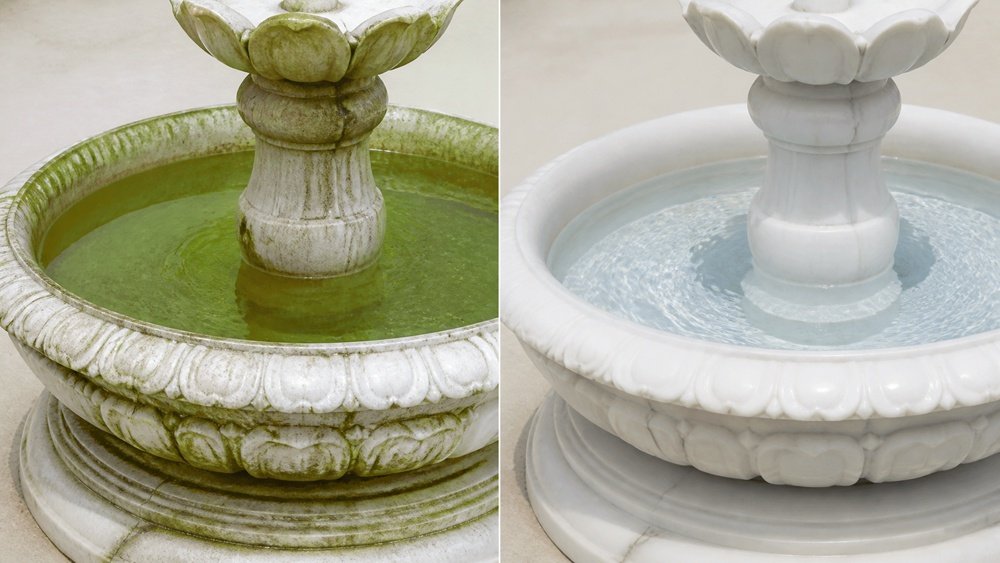
Prevention beats cleaning
⚠️ Avoid chlorine tablets and pool shock on marble. The ceramic-fountain guides online recommend them, but chlorine etches marble and corrodes joints. If your fountain is marble, use the bio-friendly options above instead.
For a deeper look at what causes algae, a full prevention checklist, and material-by-material advice, see our guide: How to Prevent Algae in Outdoor Fountains.
How to Remove Hard Water Stains & Limescale
White, chalky crust — calcium and magnesium left behind by tap water — collects at the waterline and on the pump. It is the second most common complaint after algae.
On pump parts and concealed basin surfaces: the 1:2 vinegar-and-water solution dissolves scale in 15 minutes with no scrubbing. This is the one place vinegar belongs in a marble fountain.
On visible, polished marble: never vinegar. Use a baking soda poultice (recipe above) for light white film. For thick crust that has bonded to the stone, gently chip the bulk off with a plastic scraper (never metal), then poultice the residue.
If scale has etched the surface (dull white patches where minerals sat for months), surface cleaning won’t restore the gloss — the stone itself is damaged. This requires re-polishing, which is a professional job. The honest fix is prevention: distilled water from day one, or a water softener, stops 90% of scale problems before they start.
Seal Your Marble Fountain (Why & How Often)
Sealing is the difference between a fountain that wipes clean and one that stains. A penetrating sealer (look for “impregnator” on the label) soaks into the pores and blocks water, algae pigment, and minerals from entering — without changing the stone’s look. We use a 511-series penetrating sealer on every fountain we ship; Miracle Sealants publishes clear product guidance if you want to match the sealer to your finish.
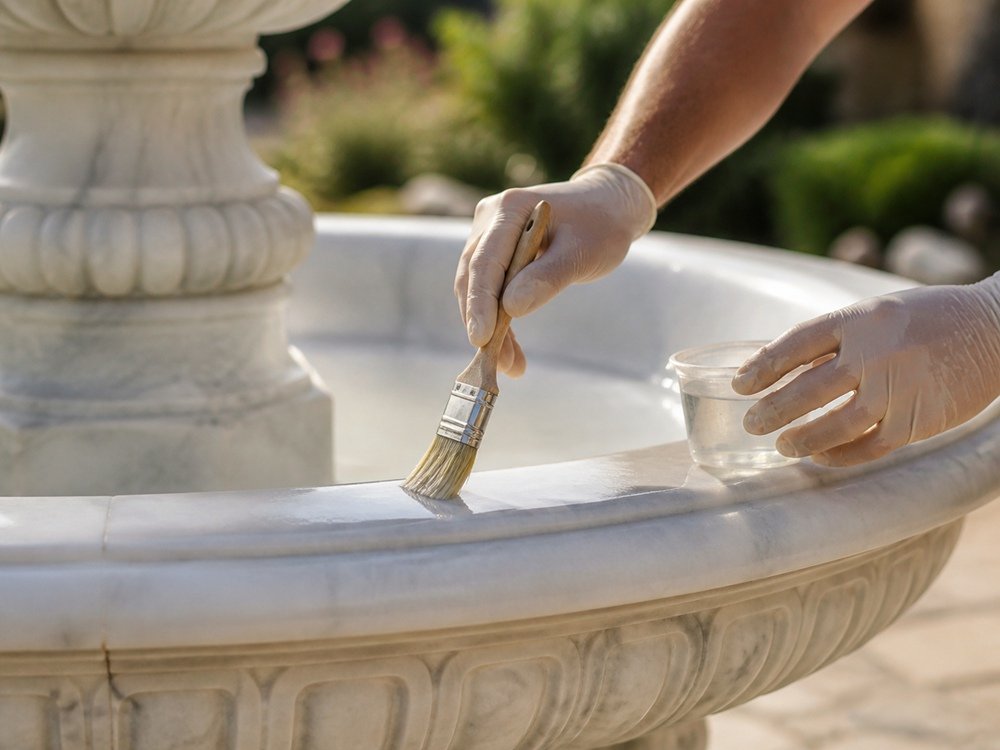
How to reseal:
- Deep-clean and fully dry the fountain (24–48 hours of dry weather).
- Apply sealer evenly with a brush or cloth; let it soak in for 5–10 minutes.
- Wipe off any excess before it dries to a film.
- Allow 24 hours to cure before adding water.
Schedule: reseal every 6–12 months, more often in hot, sunny climates where sealer breaks down faster. A quick test: sprinkle a few drops of water on the surface. If they bead up, the sealer is working; if they soak in, it’s time to reseal.
Pump Maintenance: Keep the Heart Running
Most fountain failures trace back to the pump — and most pump failures trace back to scale and debris. Service it twice a year with this teardown:
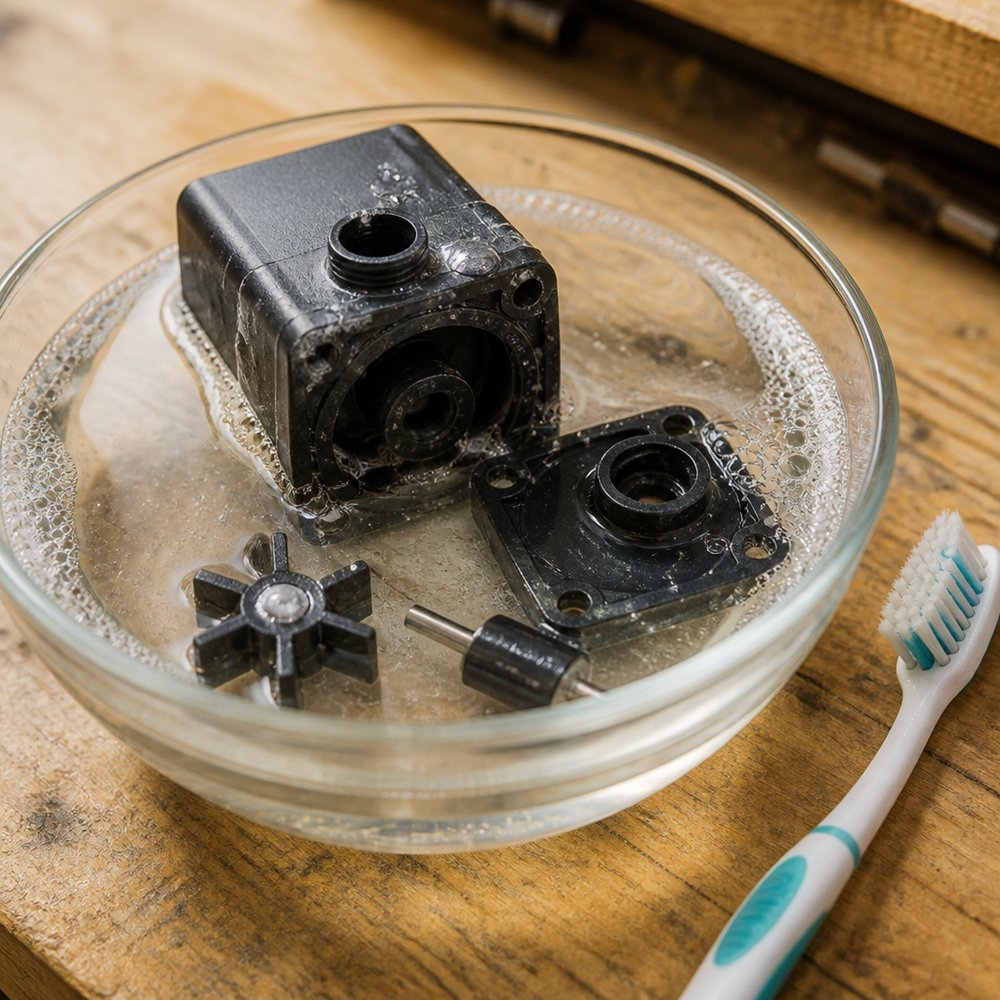
- Unplug the pump and dry the exterior.
- Open the housing (screws or clips at the base).
- Remove the impeller assembly and drive shaft; place small parts on a towel so nothing rolls away.
- Soak the parts in 1 part vinegar to 2 parts water for 15 minutes to dissolve scale.
- Scrub the housing and impeller with a soft brush or toothbrush.
- Rinse every piece in clean water and reassemble.
- Dry the plug before reconnecting.
Three pump rules from our service department:
- Never run the pump dry — even 30 seconds of dry running can burn out the motor. Check water levels weekly.
- Never run the pump out of water while cleaning — the same dry-run risk applies.
- Store the pump indoors for winter — freezing water inside the housing cracks it.
Quick diagnostics: weak flow = clogged intake or low water; noisy or sputtering = low water (pump drawing air); not pumping at all = debris in the impeller or pump not fully submerged.
Winterizing Checklist
If temperatures in your area drop below freezing, winterizing is not optional — water expands when it freezes, and expansion cracks marble and bursts pumps. The Natural Stone Institute’s care guidelines stress the same point for porous stone. Do this before the first freeze:

- Drain all water from the basin and any bowls
- Remove, clean, and store the pump indoors
- Disconnect and drain tubing
- Cover the fountain with a waterproof, breathable cover, secured against wind
- Store removable decorative pieces (finials, urns, statuary) indoors
- Remove standing water anywhere it can collect and freeze
In spring, remove the cover, rinse, refill, and reseal if the water test shows the sealer has worn.
For the complete step-by-step winter routine — draining, insulation, removable parts, and regular inspection — see our guide: How to Maintain an Outdoor Marble Fountain in Winter.
Repairing Cracks, Chips & Etching
Small chips and hairline cracks: a marble repair kit (epoxy tinted to match the stone) fills them invisibly for small damage. Follow the kit’s instructions; sand flush with fine grit once cured.
Larger cracks, loose bowls, or deep etching: call a professional. A cracked bowl that leaks will erode its base and pump over a single winter — repair is far cheaper than replacement. One note from our workshop: cracks almost always start at pre-existing weak points, which is why we pressure-test every fountain before shipping — a step worth asking your supplier about.
Troubleshooting Table
FAQ
How often should I clean my marble fountain?
Wipe and top up water weekly, change the water monthly, deep-clean every 1–3 months (monthly in hot, sunny, or dusty spots), service the pump twice a year, and reseal every 6–12 months.
Can I use vinegar to clean a marble fountain?
Only on pump parts and concealed, unpolished basin surfaces, diluted 1:2 with water. Never use vinegar on polished or visible marble — it causes permanent etching.
Can I use bleach to clean a marble fountain?
No. Bleach etches, yellows marble, and chlorine corrodes joints. Use pH-neutral stone soap for cleaning and 3% hydrogen peroxide for algae.
Is fountain algaecide safe for birds and pets?
Only if the label explicitly says safe for pets, birds, and wildlife. Refreshing the water monthly is the gentlest algae control of all.
Should I run my marble fountain all the time?
Running it discourages algae and mosquitoes and keeps the pump healthy — just keep the water topped up so the pump never runs dry.
Do I really need to winterize a marble fountain?
Yes, in any climate that freezes. Water left in marble expands when frozen and cracks the stone; freezing also bursts the pump. Drain, cover, and store the pump indoors.
How often should I seal my marble fountain?
Every 6–12 months, or whenever a water-drop test shows water soaking into the stone instead of beading.
Keep Your Marble Fountain Beautiful for Decades
A marble fountain is one of the few garden features that genuinely lasts generations — but only with the right care. Clean with pH-neutral products, resolve the vinegar question correctly (pump yes, polished marble no), refresh the water monthly, service the pump twice a year, seal annually, and winterize without fail.
If you are choosing a new fountain, or want to see the construction behind a fountain built to be easy to maintain, browse our marble fountain collection — every piece is carved, sealed, and pressure-tested before it ships, so the care routine above is all the maintenance it will ever need.