The short answer: A heavy stone ball rests in a stone socket carved to fit it exactly. A pump pushes water up into the socket, and the water squeezes out between the ball and the socket as a very thin film. That film carries the weight of the ball and reduces friction to almost nothing — so as long as the pump is running, the ball keeps turning, slowly and steadily.
You may also see this water feature called a kugel fountain, a kugel ball, a floating sphere fountain, or a rolling sphere fountain. They all mean the same thing.
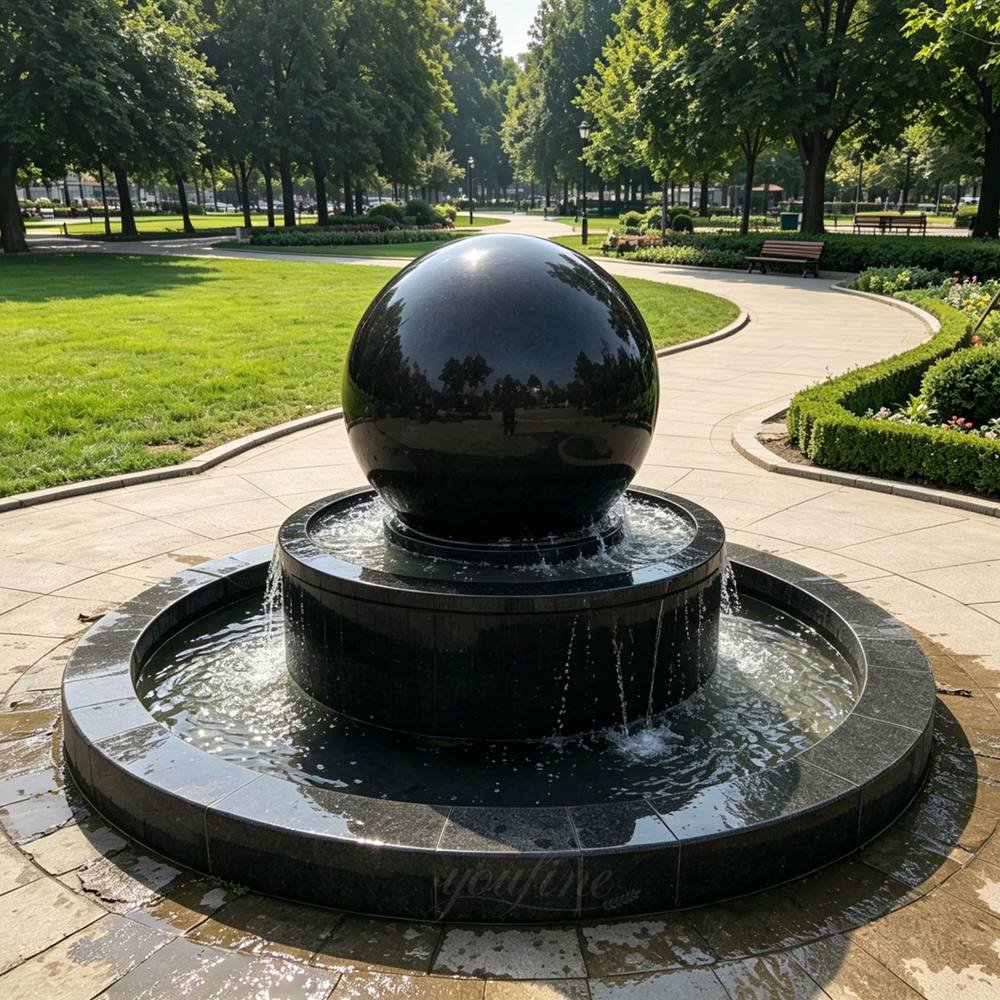
What’s inside a marble ball fountain?
Every marble sphere fountain comes down to five main parts. (If you’d like to see what these look like in a garden, our marble sphere fountain range shows the usual sizes and bases.)
1. The sphere. A solid ball cut from a single block of natural stone and polished with care. Because stone is natural, no two spheres have the same veining. There is nothing mechanical inside it.
2. The socket (the concave base). A curved surface shaped to match the ball’s curve, with a pressure chamber and a few water channels hidden inside. The socket is tilted very slightly, or has shallow guiding grooves cut into it — that’s the detail that keeps the ball turning.
3. The pump. The only part that uses electricity. It pressurises the water and sends it into the socket. A quiet submersible pump is usually used.
4. The basin. It catches the water that spills off the sphere and holds it for recirculation.
5. The load-bearing base. It carries the socket and the whole stone ball, so it needs real strength and proper waterproofing.
Of these five, the one that decides whether the ball turns at all is the fit between the sphere and the socket — so let’s start there.
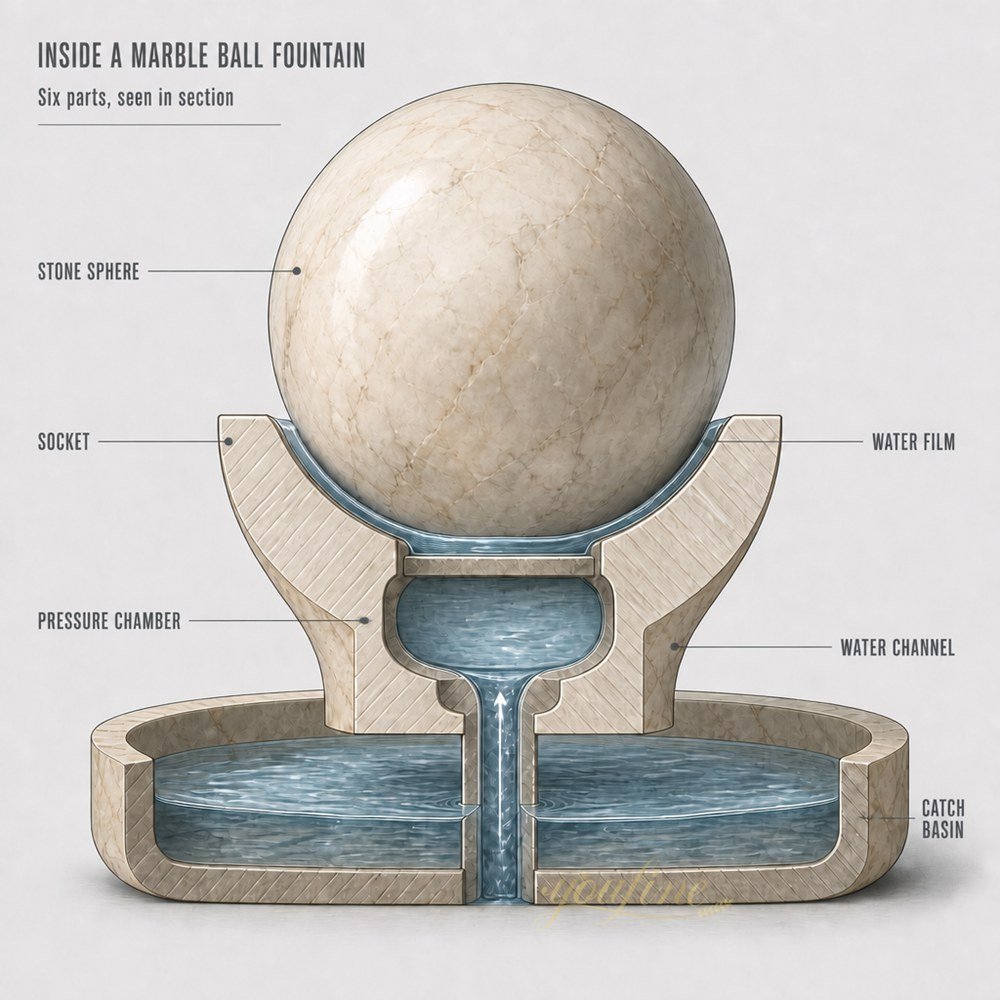
How it works: the socket is really a water-bearing
Many people assume something mechanical must be holding the ball up. It isn’t. What’s doing the work is the water itself — engineers call this arrangement a hydrostatic bearing, meaning a bearing that carries a load on a film of pressurised fluid. Here, the fluid is simply water.
Step 1: Water is pushed into the socket from below
The socket is hollow inside. It holds a small pressure chamber and a few channels that spread the water out. The pump lifts water from the basin and pushes it into the centre of the socket.
Step 2: Water squeezes out as a thin film
The ball and the socket aren’t pressed tight against each other — there’s a very fine gap between them. Water is forced into that gap and spreads evenly around the ball’s curve, forming a complete film. It’s so thin you can barely see it.
Step 3: The film carries the ball’s weight
The pressure inside the film is spread evenly across the lower half of the ball. However heavy the ball is, the film pushes back just as hard. The two sides balance, and the ball sits there steadily.
Here’s a comparison that helps: a hovercraft doesn’t float on water — it rides on a cushion of pressurised air. A ball fountain does the same thing, with water instead of air.
One key point: the ball is held up by water, not propped up by any mechanical part. There is nothing inside it. It’s a solid piece of stone.
Why doesn’t such a heavy stone ball squeeze the water out?
This is the part people find hardest to believe, and it’s the most useful part of this article. You might be thinking: the ball can weigh over two tonnes (4,400 lb or more). Sitting on a gap that fine, wouldn’t it just squeeze the water out and drop onto the socket?
It won’t, for three reasons.
First, water barely compresses. You can’t squash water down the way you squash a sponge. So when the ball presses down, the water doesn’t vanish — it can only escape through the gap, and escaping takes time.
Second, the narrower the gap, the harder it is for water to get out. This is the counter-intuitive bit, and it’s what keeps everything stable. When the ball settles down a fraction, the gap between ball and socket narrows, the water meets more resistance on its way out, and the pressure inside rises — and that rising pressure lifts the ball back up to its balanced height.
In other words, the system finds its own balance. If the ball drops, the pressure lifts it. If it rises, the pressure eases off. It never sinks all the way down.
Third, the pump keeps topping the pressure up. A little water is always escaping and falling into the basin below, and the pump keeps replacing it, so the pressure stays steady, and the loop stays closed.
So the answer is simple: the water can’t be squeezed out, because the ball pushes down while the pump pushes back — and the two balance out.
Why does the ball keep turning on its own?
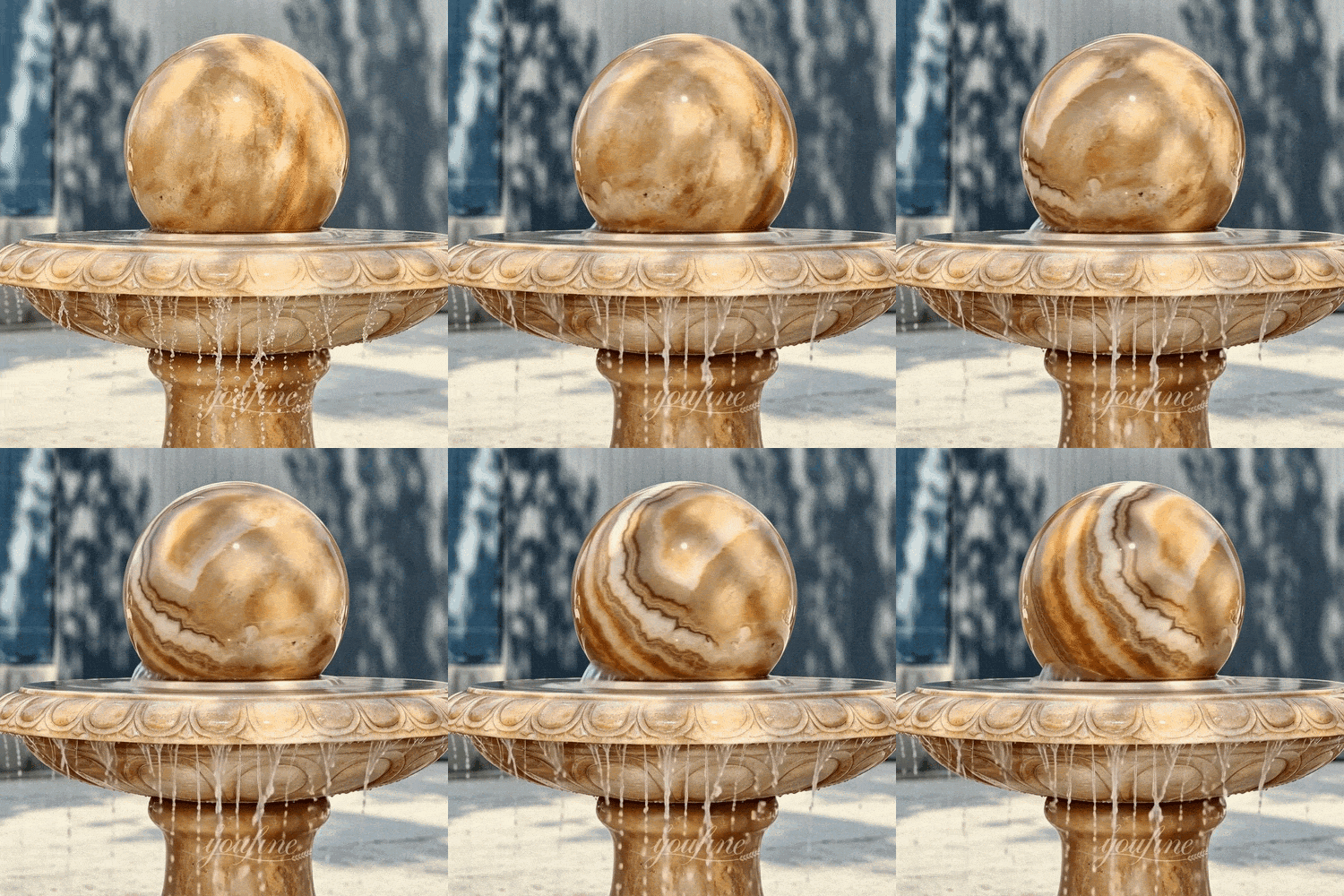
The ball turns so slowly and so smoothly that it looks like someone is pushing it. What’s pushing it is the water, and it comes down to one small detail in the socket. Here’s how it works, step by step:
- The socket isn’t perfectly level. The concave surface the ball sits in is tilted very slightly, or has shallow guiding grooves cut into it.
- So the gap isn’t the same width all the way round. One side is a little narrower, the other a little wider. Where the gap is narrow, the water pressure is higher; where it’s wider, the pressure is lower.
- That pressure difference becomes a push. Because the two sides differ, there’s a gentle force always pointing in the same direction — enough to keep the ball turning slowly. Nobody has to touch it. As long as the pump is running, the ball turns.
- What it feels like by hand. With a film of water between ball and socket, stone never grinds on stone. Friction is almost zero, so a light push sends the ball turning easily.
- But low friction doesn’t mean it stops at a touch. The ball is solid stone — heavy, with a lot of rotational inertia — and the tilted socket keeps pushing it. So it carries on turning, and stopping it takes a bit of effort too.
- The heavier the ball, the steadier it turns. More inertia means less wobble and less disturbance from small changes in the water flow. A heavy ball does need more pressure to lift, though — so weight isn’t a problem, as long as the pump is matched to it and holds steady pressure.
That’s also why these fountains feel a little magical: the movement is slow, calm and quiet. No gears, no motor hum.
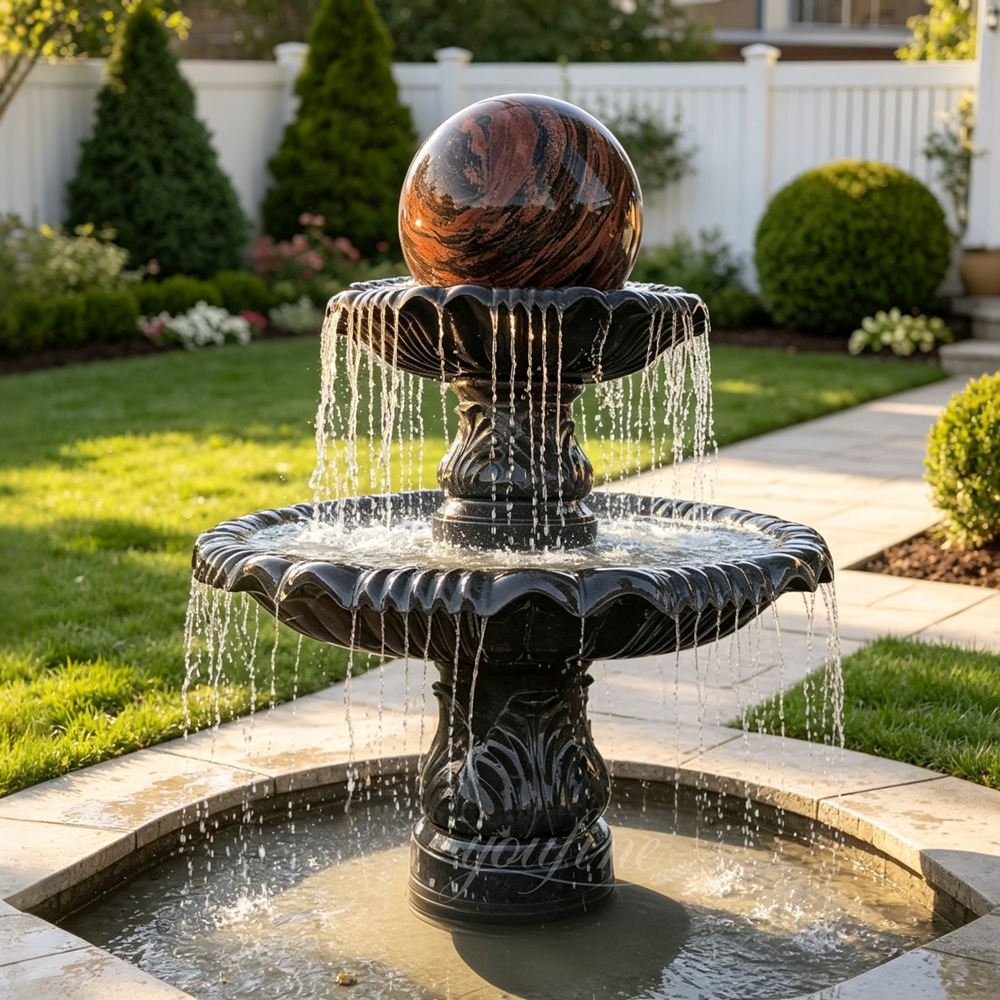
Two myths you’ll see everywhere
Search around, and you’ll find plenty of explanations. These two are wrong, and they’re worth clearing up.
Myth 1: the ball floats on buoyancy. No. Stone is much denser than water — if buoyancy were all that held it up, the ball would sink straight to the bottom. Buoyancy only carries a tiny fraction of the weight. What really holds the ball is the pressure in the water film.
Myth 2: surface tension holds the ball. Also no. Surface tension is very weak — strong enough for a water strider to stand on, nowhere near strong enough to hold up a stone ball weighing tonnes. It’s the pressurised film that does the work.
What makes one ball fountain turn better than another?
Two fountains can look identical, yet one turns sweetly for years while another feels gritty within a year or two. It usually comes down to five things.
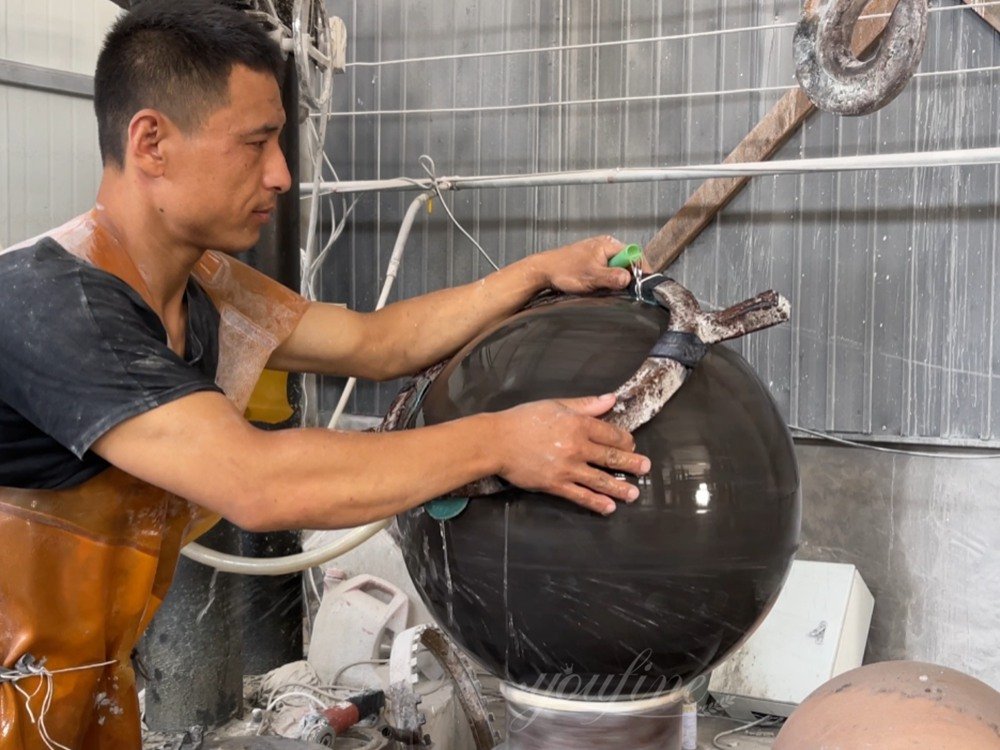
1. How precisely the sphere and socket match. They’re made as a pair — you can’t swap one for another. The gap has to be the same width all the way round. If one side is wider, the pressure spreads unevenly, and the ball starts rubbing. This is the most demanding step in the whole process, and it’s also what makes an accurate tilt or guiding groove possible in the first place.
2. How well the sphere is polished. The smoother the surface, the more stable the film. A rough surface makes the water flow turbulent, the film can’t hold the ball properly, and dry rubbing follows.
3. Whether the pump pressure matches the weight of the ball. Too little pressure and the ball can’t lift — it drags on the socket. Enough pressure, but unstable, is just as bad. So when choosing a pump, the question isn’t how powerful it is, but whether it can hold a steady pressure matched to this ball.
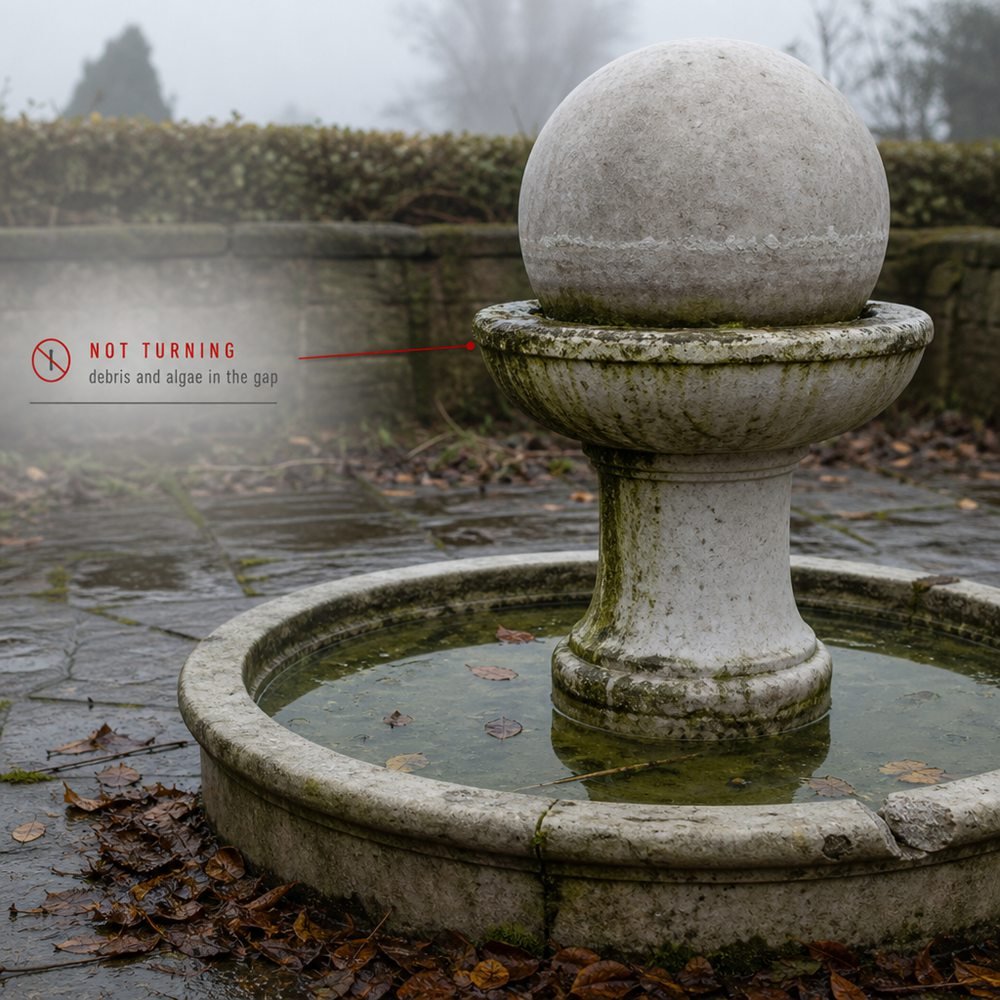
4. Whether the water path is clear, with no dead spots. Water needs a clean route from the pressure chamber back to the basin. If the basin has corners the flow never reaches, debris settles there, builds up, and eventually blocks the channels.
5. How clean the water is. Sand grains are quartz, and quartz is harder than stone. Once grit gets into the gap, it scratches the sphere. Enough scratches and the film becomes unstable, and wear speeds up. Keeping the water clean and clearing leaves and debris is the easiest way to make the fountain last.
What makes a ball fountain stop turning?
There are five common causes. This table is a quick way to check:
We’ve written the step-by-step checks for each one in a separate guide — troubleshooting a sphere that has stopped rotating — so we won’t repeat them here.
Frequently asked questions
Q1. Does the marble ball have a motor inside?
No. It’s a solid ball of stone with no motor, no magnets, and no moving parts inside. What keeps it turning is the pressure difference created by the slight tilt and the guiding grooves in the socket.
Q2. Is the floating water ball fountain noisy?
Very quiet. The water film sits between the ball and socket, so there are no gears and no drive parts — no mechanical noise at all, just the soft continuous sound of water spreading over the stone. If the splashing gets loud, raise the basin water level slightly to shorten the drop.
Q3. Can it work outdoors in all weather?
Yes — natural marble and granite both resist UV and weathering, so they’re happy outdoors all year. Just two things to keep up: drain the basin and pipework before frost in cold regions, and clear leaves, algae, and grit regularly.
Q4. Will the ball stop rotating after years of use?
No. There are no wearing drive parts in the system, so a well-matched sphere and socket keeps turning for many years — what actually stops a fountain is something external, such as an ageing pump, a low water level, debris building up, or frost.
Q5. How do I maintain a marble ball fountain?
Day to day, it’s little more than wiping the sphere and basin, keeping the water level up, clearing leaves and debris, and making sure the pump stays submerged. In cold regions, drain the pipework before winter; if mineral marks appear, use a mild neutral cleaner only — never an acidic cleaner, which etches marble.
Q6. Marble or granite — which one should I choose?
Both turn in exactly the same way; the difference is where you put them. Marble has distinctive veining and takes fine carved detail, so it suits gardens and private villas. Granite is harder and handles frost better, so it suits large spheres, public sites and cold climates.
Q7. What pump do I need?
What matters isn’t wattage — it’s whether the pressure is enough to lift this particular ball, and whether it holds steady. Avoid high-flow pool pumps: when the pressure fluctuates, the film becomes unstable, the ball feels gritty, and the sphere surface gets scratched over time.
Q8. What sizes are available, and how much do they cost?
Size is measured by the sphere diameter, and both weight and price follow from it: under 60 cm is usually around 1,000–2,000, 60–120 cm around 2,000–7,000, and over 120 cm from $7,000. What the ground carries is the total — sphere, base and water together — so here are two common sizes for reference:
Sphere weights are estimated using a natural stone density of about 2.7–2.8 g/cm³; your actual stone may differ. Base diameter is usually 1.4–1.5 times the sphere diameter, and base weight is usually 1.5–2 times the sphere weight (industry reference). Final price depends on the stone, the carving and the destination.
Final Thoughts
A marble ball fountain looks like magic, but the idea is easy to follow: the pump pressurises water, the water forms a thin film between the ball and socket, and that film carries the weight of the ball while removing almost all friction. The slight tilt and guiding grooves in the socket create a pressure difference on either side, and that difference keeps the ball turning.
So nothing electrical drives the ball, and there’s no hidden mechanism — the water itself does the turning. If you’d like to buy a marble ball fountain that suits your space, send us photos of the site, the dimensions, and the style you like, and we’ll recommend the right design, size and material for you.